Recital for Voice and Violin
Performance at Jorge Martínez Reverte Municipal Library, Bustarviejo, Madrid 2023
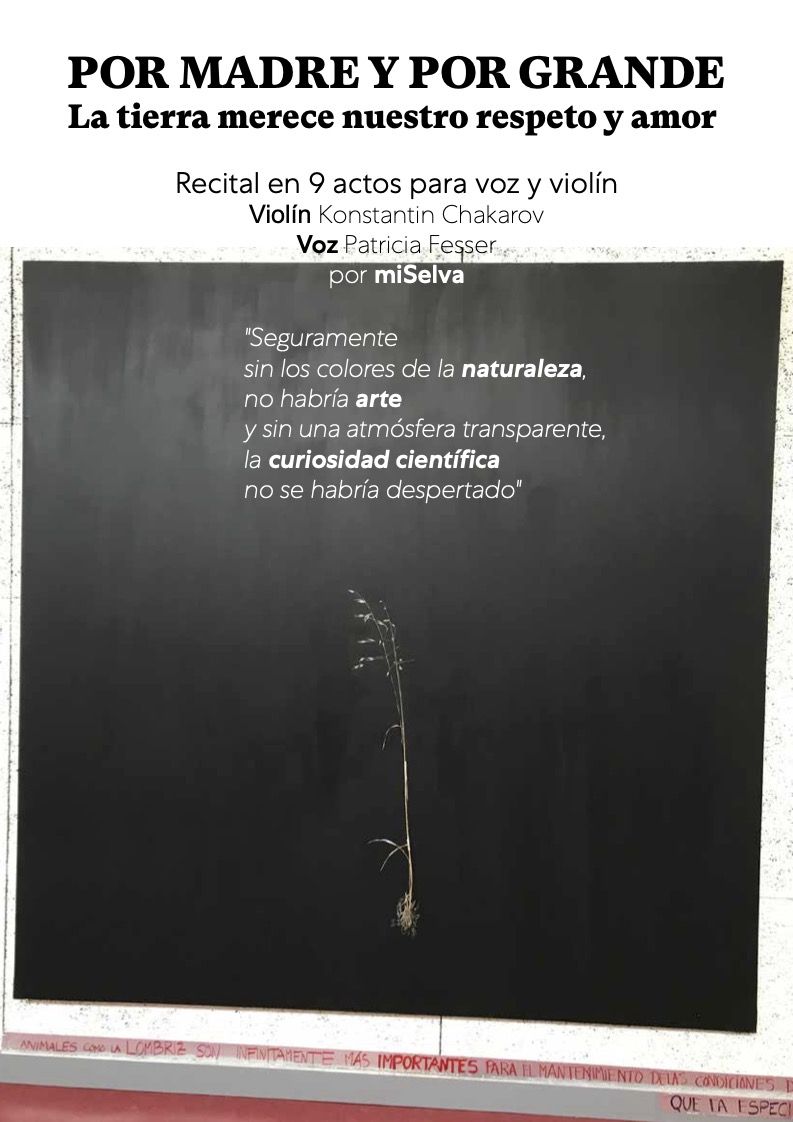
FOR BEING MOTHER AND FOR BEING SO BIG
Earth deserves our respect and love
Recital in 9 acts for voice and violin
Violin Konstantin Chakarov
Voice Patricia Fesser
by miSelva
Without the colors of nature, there would probably be no art, and without a transparent atmosphere, scientific curiosity would not have been awakened.
1. The curse of Narcissus
We, as human beings, are a creation of nature: its work.
Nature, its works, are enormous, infinite, beyond measure, and, from our perspective, we have been able to explain very little about its own rationality.
We attend with astonishment the explanations of how our bodies or any balanced ecosystem works, and yet we are unable to recognize that intelligence.
Because only our intelligence is intelligence, we say. The curse of Narcissus.
2. Superweeds
Non-human nature1: it is not only humans who rebel against the misuse and abuse of the resources that the (fertile) earth gives us, but also nature itself: superweeds. There is an open war in which superweeds are capable of defeating the herbicides that try to protect genetically modified crops.
Capitalism has given us centuries of enormous visual enjoyment: our societies were filled with shapes and colors, comforts and magic. However, all this has been possible because most of the work required to achieve it has not been valued: the work done by nature (ecosystem functions) accounts for between 70 and 250% of GDP, and the care work done by women throughout this development accounts for 70-80% of GDP.
Both have been excluded from the world’s accounting books.
This economic system is having effects that are contrary to the needs of our own existence. Vertebrate populations have declined by 94% between 1979 and 20162.
We are dominating the world, but that is not our place3.
3. Socratic logic
>Nature does not write books in which it analyzes itself and draws conclusions to adapt its behavior and habits, as we do. Really? Can nature—in the form of animals, plants, minerals—read and understand our books? On the human planet, we think not; therefore, applying our cherished Socratic logic, we can deduce that we would not be able to understand theirs either. In fact, we demonstrate this emphatically.
If we see that nature articulates responses and changes ecosystems, material mechanisms, and their articulation completely over time, what enables us to dismiss this as an action of its will and consciousness?
4. Religious beliefs… sorry, I meant scientific ones!
I know I’m up against centuries of beliefs supported by scientific research, but these, in their ultimate capacity, prove insufficient to grasp the complexity of life.
We will have to wait for science to explain the parallel between what we believe is exclusive to our species—intelligence, consciousness, the rational development of knowledge—and its manifestation in the living world of which we are a part.
Plants use a language that science is only very slowly uncovering.
5. Genetics
The human genome has 26,000 genes, while the rice genome has 50,0004.
The more is better! So, is rice more evolved than the human species?
As long as the human species thinks that animals, plants, or minerals don’t feel, animals will sense that humans don’t think.
6. Anthropogenic Mass
In a handful of healthy soil, there are more living organisms than there are people in the world.
However, the total mass of cement produced by humanity would be enough to cover the entire planet Earth with a 2mm layer. The mass of all materials produced on Earth has likely grown to equal the mass of all life on the planet (biomass5).
The mass of the Eiffel Tower is equivalent to that of 10,000 rhinoceroses.
The mass of New York City is equivalent to that of all the fish in the world.
The planet has progressively more buildings than trees.
7. Plants in Motion
Humans say, believe, think, teach, and argue that plants don’t move. But if plants didn’t move, how could they exist throughout the world? Plants do move. A lot.
And how do plants move?
Besides using animals, they do it autonomously.
How?
By growing—GROWING!
It could be legs or feet that move the body of an animal, or cells that multiply. The mechanism may vary, but the behavior is the same6.
8. Intelligence (Sacrosanct) and Society
Memory is another criterion humans use to identify intelligence, so do plants have memory? The dancing plant -Codariocalyx motorius- was taken from the wild at a very early stage of its growth. The first few times it was exposed to music, it moved very clumsily, but after a few days of exposure, it began to dance like a ballerina.
Thus, we clumsy humans were able to identify this plant’s capacity to train, a capacity that, as humans well know, is based on memory7.
Plants are able to perceive each other and their environment, they are able to communicate these perceptions, they have memory, they are able to process vast amounts of information and practice active attention, caring for their offspring and elders, learning from the past and planning for the future, cooperating for the benefit of the species8.
Plants are able to perceive each other and their environment, they are able to communicate these perceptions, they have memory, they are able to process vast amounts of information and practice active attention, caring for their offspring and elders, learning from the past and planning for the future, cooperating for the benefit of the species.
9. Conclusion
Producing a cotton shirt requires 2700 liters of water, the same amount a person needs for two and a half years to drink.
- Jason W. Moore ‘Capitalism in the web of life’
- World Wide Fund of Nature (WWF)
- Dr. Stephan Harding
- Profesor Francis Hallée
- Institute of Science Weizmann, WIS, Rejovot, Israel.
- The secret Life of plants, – BBC Nature Documentary
- The secret Life of plants, – BBC Nature Documentary
- The secret Life of plants, – BBC Nature Documentary